De Verlenging: when a dug-out becomes part of the raw materials policy
"De Verlenging" is a dug-out with a circular story!

Want to know more?
Peter Ruigrok

A player might not like being in De Verlenging. But the extension is the place where the difference can be made. Here you can win a match, but also lose. In our "Extension" you always win.
With "De Verlenging", W&H introduces a (modular) dug-out in which worn artificial turf from sports fields gets a new function. Not as production waste, but as a raw material for a next product at the sports park. This extends the material life cycle into a new product.
A dug-out belongs to a sports field. Just like goals, markings, lighting and fencing. But at the sports park of the future, it’s not only about the product’s function. The origin of materials, their service life, and what happens to them after use also become part of the consideration.
That calls for a different way of setting up a sports facility.
Not just: what do we need to buy?
But precisely: which raw materials do we already have?
With De Verlenging, W&H brings that idea literally to the touchline.
Artificial turf becomes new raw material
The dug-out construction is made of aluminium. The back and side walls, seating bench and backrest are built with planks made from recycled artificial turf from worn artificial turf fields.
That distinction is important. The material does not come from production waste that has never been used before. The artificial turf has already completed its first life phase on a sports facility. After that, it is processed into raw material for a new application.
From playing field to dug-out. That is sports-circular thinking in a practical form: keeping materials from the sports sector within a new use cycle for as long as possible.
How much artificial turf is there actually in it?
In two dug-outs, about 580 kilograms of former artificial turf are processed. But what does those 580 kilograms mean? To make those 580 kilograms valuable, we made it visible. To put it into perspective, we took a football pitch as an example.
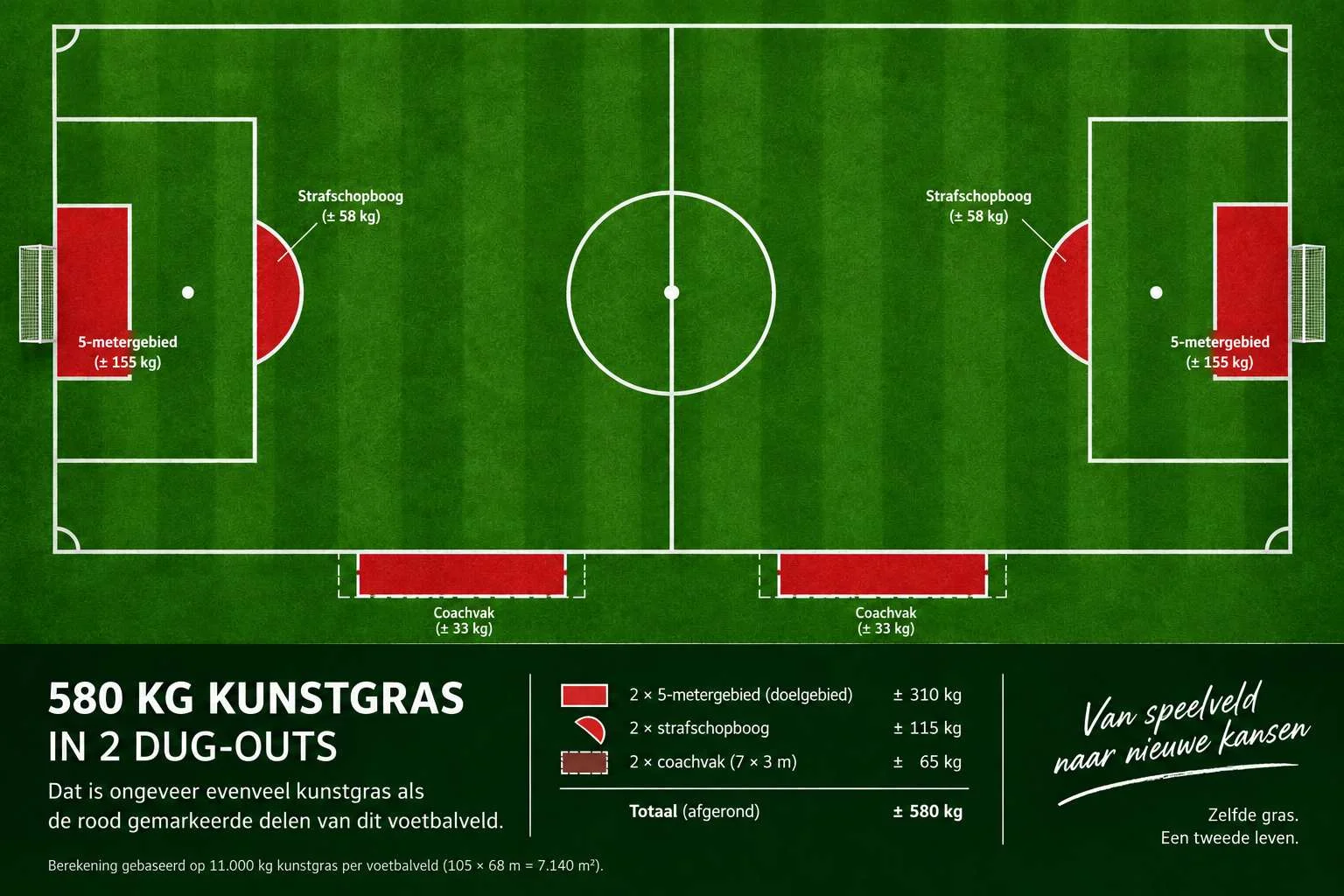
On a football pitch of 105 × 68 metres and about 11,000 kilograms of artificial turf, 580 kilograms roughly corresponds to the red-marked areas in the illustration: two 5-metre areas, two penalty arcs and two coach boxes of 7 × 3 metres.
The football pitch is explicitly a calculation example. The raw material can of course come from different artificial turf sports fields. Think also of hockey, korfball and other sports where artificial turf is used.
So it’s not about the sport.
It’s about the raw material.
The circular economy becomes visible at the sports park
Circularity sometimes stays stuck in policy documents, percentages and material flows. At a sports park, it can become much more tangible.
You’re on it.
You lean against it.
You can see where the material is used again.
That’s how De Verlenging connects to a development that is increasingly becoming part of the raw materials policy of municipalities, sports organisations and operators: using fewer primary raw materials, keeping materials in use longer and already thinking about the next life phase when making new investments.
After all, a circular economy doesn’t start with recycling alone.
The long service life of a product is at least as relevant.
That’s why De Verlenging is built robustly from aluminium and recycled plastic parts. At the end of the usage phase, the applied materials can be recycled again, provided they are separated and processed via suitable recycling streams.
Even the transparent polycarbonate that can be used in one of the versions is technically recyclable and can be used again as raw material after separation.
At delivery, a guarantee statement for the raw materials and a REACH statement are included.
A dug-out that can literally be extended
The name De Verlenging has a third meaning.
The dug-out is built in sections of one metre. This makes it possible to adapt the length to the facility and the desired number of seats. Whether you need a dug-out of 5, 6 or 7 metres. We produce it to measure!
De Verlenging is available with a fully enclosed back wall or with a back wall whose upper section consists of transparent polycarbonate.
Because although a substitute player might prefer to keep their stay in the dug-out as limited as possible, enough space along the touchline is not an unnecessary luxury.
Move More. Waste Less.
With Move More. Waste Less., W&H chooses a direction in which moving and material use are explicitly linked.
A sports park must invite people to sport and move. At the same time, the same place calls for choices about materials, waste streams, service life and future reuse.
That doesn’t have to be a contradiction.
De Verlenging shows how a functional product at a sports facility can also be part of a broader circular economy.
After years of intensive use, an artificial turf field has lost its function as a sports floor.
The raw material hasn’t.
De Verlenging
Move more. Waste less.


